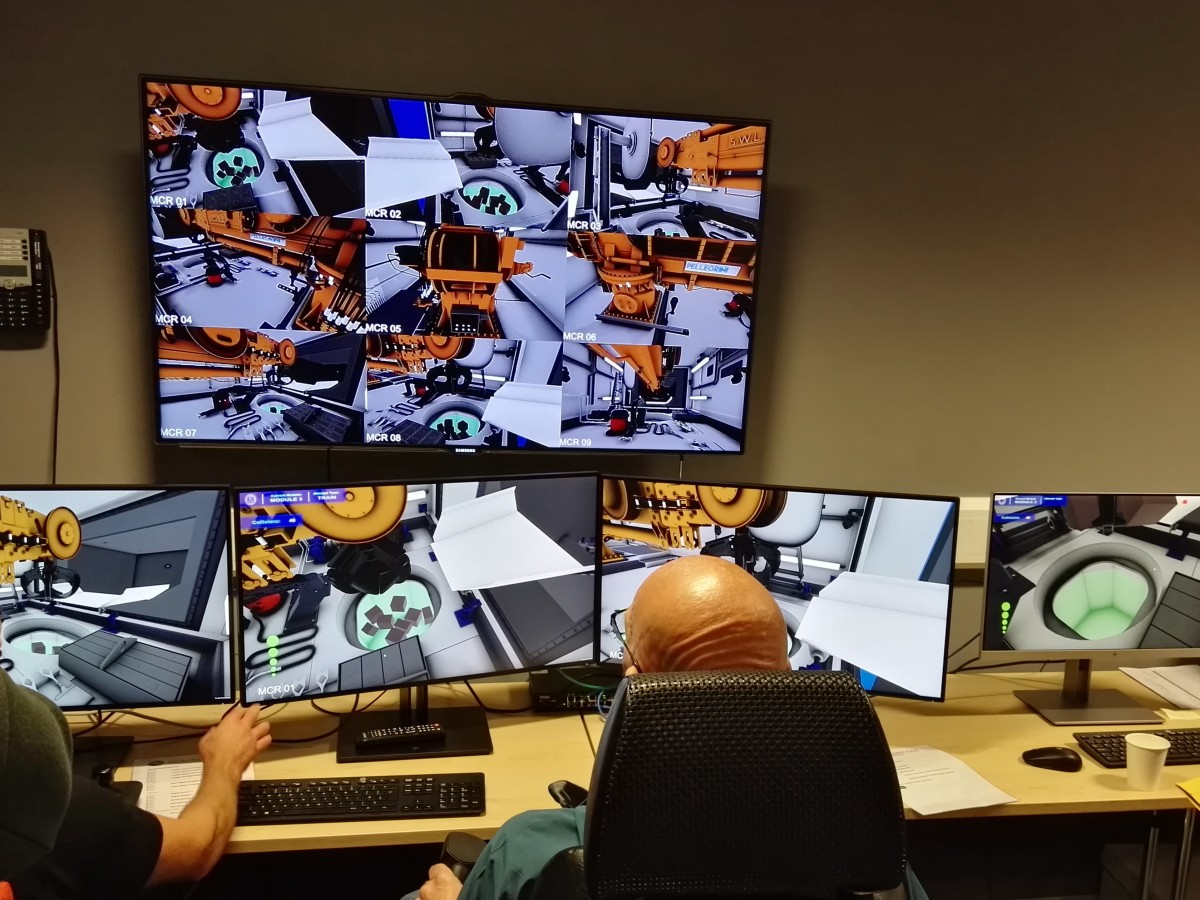
Sellafield approached the VEC’s digital experts with a challenge to understand how Virtual Reality (VR) could be used to train and ensure the safety of the specialist operators of its newly commissioned nuclear waste removal crane, designed to scoop up and remove hazardous material from Sellafield’s 70-year-old Pile Fuel Cladding Silo.
The building was originally designed to be permanently sealed, meaning innovative ways of accessing and retrieving the waste have had to be developed.
Experts at the VEC, part of University of Liverpool, met with the Sellafield team at the VEC innovation centre at Sci Tech Daresbury and, using existing Sellafield 3D design models, created a simulator of the silo and crane. Using an exact replica of the crane’s operator chair, control joystick and spatial working environment, together with selected digital tools, a precisely scaled immersive, mixed reality model of the crane and its operating waste removal environment was created.
The crane training simulator has provided a realistic environment for Sellafield’s operators, allowing them to learn to ‘drive’ the nuclear waste retrieval crane in a safe environment, before the full scale training environment was available, ensuring greater levels of safety whilst increasing productivity, by building operator confidence quickly and reducing the overall project delivery schedule.
Sellafield has been so impressed with the simulator that the silo waste retrieval team has made the decision to use it as the primary tool for crane operator training. This has allowed Sellafield to re-purpose the full-scale training rig it had originally planned to use, as a second retrieval system, saving £20m on the cost of future waste retrievals.
The VEC and Sellafield collaboration has also recently achieved a highly commended in the Safety in Innovation category at the Nuclear Decommissioning Authority Safety and Wellbeing Awards.
Lynn Dwyer, Head of Commercial for the VEC, said: “As a team we are extremely proud of this project. It showcases the in-house expertise we have at the VEC. It was a pleasure to work with the Sellafield team to produce a cutting-edge training solution that has reaped huge cost and productivity savings.”